Inclusive Playground Design Team
Children With Disability NZ
About Lauren
I am Lauren, an adviser with Children With Disability NZ. I bring lived experience, experience as a parent, and knowledge from my social work studies.
I am autistic and have ADHD, so my understanding of disability and neurodiversity comes not only from being a parent and advocate, but also from my own lived experience. I am a parent of a child with autism and another child who is beginning the assessment journey.
These different perspectives have shaped how I view inclusion. They have taught me that what may seem like a small barrier to one person can significantly impact someone else, and that we need to listen to a wide range of lived experiences when designing our communities.
I have a strong passion for advocacy across several areas, particularly disability and supporting people who have been subjected to abuse. At the heart of my advocacy is a goal of creating meaningful, positive change in people's lives and within our communities.
Why Inclusive Playgrounds Matter to Me
My passion for inclusive playgrounds mainly comes from my experiences as a parent.
Taking my children to a playground hasn't always been the simple, enjoyable family outing people might expect. My children at times elope. I assumed they would grow out of it as they got older; they haven’t. At times, they have run in different directions. This can be incredibly frightening, particularly when playgrounds are located near busy roads, waterways, or other hazards.
Consider the entire environment. Fencing, safe entry and exit points, visibility for parents and caregivers, sensory needs, quiet spaces, seating, communication supports, accessible pathways, and the overall playground layout can make an enormous difference.
I also saw this firsthand when my child was using a communication board.
The first time my child saw a communication board at a playground, their face lit up. It was wonderful to see something that recognised how they communicated. However, that excitement faded when we realised where the communication board was placed.
The board was outside the main play area. To use it, my child had to stop playing, leave the other children and go over to the board to point to what they wanted to communicate. The other children did not always understand that my child wanted them to follow.
That experience stayed with me. It showed why lived experience needs to be involved in playground design from the start. It is not enough to simply include an accessible or communication feature, or play equipment. We also need to think carefully about placement and how a child will use it while playing with others.
Why Glen and I Are Working Together
I began working with Glen because we share a strong interest in advocating for inclusive playgrounds.
Glen brings decades of lived experience as a person with a disability and wheelchair user, together with his advocacy work through Children with Disability NZ and his involvement in accessible playground projects. Since working with Glen, I have learnt a lot about accessibility for wheelchair users. Now every time I leave the house, I can’t help but see how inaccessible our communities are.
Our experiences are different, and we believe that is one of the strengths of working together.
We both believe accessibility and inclusion shouldn't be added after a playground has already been designed; sometimes accessibility isn't even considered at all. Disabled people, children, parents, caregivers and others with lived experience should have opportunities to contribute to planning from the beginning.
Importantly, we recognise that no single person's lived experience represents everyone.
The barriers I experience, or notice, may be completely different from those Glen experiences. Likewise, another person, child, parent or caregiver may identify challenges that neither of us has encountered.
That is why listening, consultation, and communication matter so much.
By bringing different perspectives together, we can better understand the physical, sensory, communication, safety and social barriers that can prevent children and families from fully participating in play and their community.
Our goal is not simply to make playgrounds accessible.
We want to advocate for playgrounds that are genuinely inclusive, places where disabled and non-disabled children can play, communicate, explore and belong together.
Our Playground Design
As Glen and I began discussing and developing the inclusive playground design, we found ourselves drawing on much more than our own experiences.
We started by talking about what we had witnessed, the challenges people we knew and cared about faced, the barriers we had read about others facing, and the small details that can make the difference between a child being able to access a playground and actually enjoying it.
We realised the playground we were wanting to design included a little bit of everyone.
We also wanted to design something our community could feel excited about, believe in, and proudly advocate for together. Something that would inspire people to keep speaking up and encourage councils to listen. We acknowledge that people have been doing this for some time, and we appreciate every voice and advocate who shares our goal.
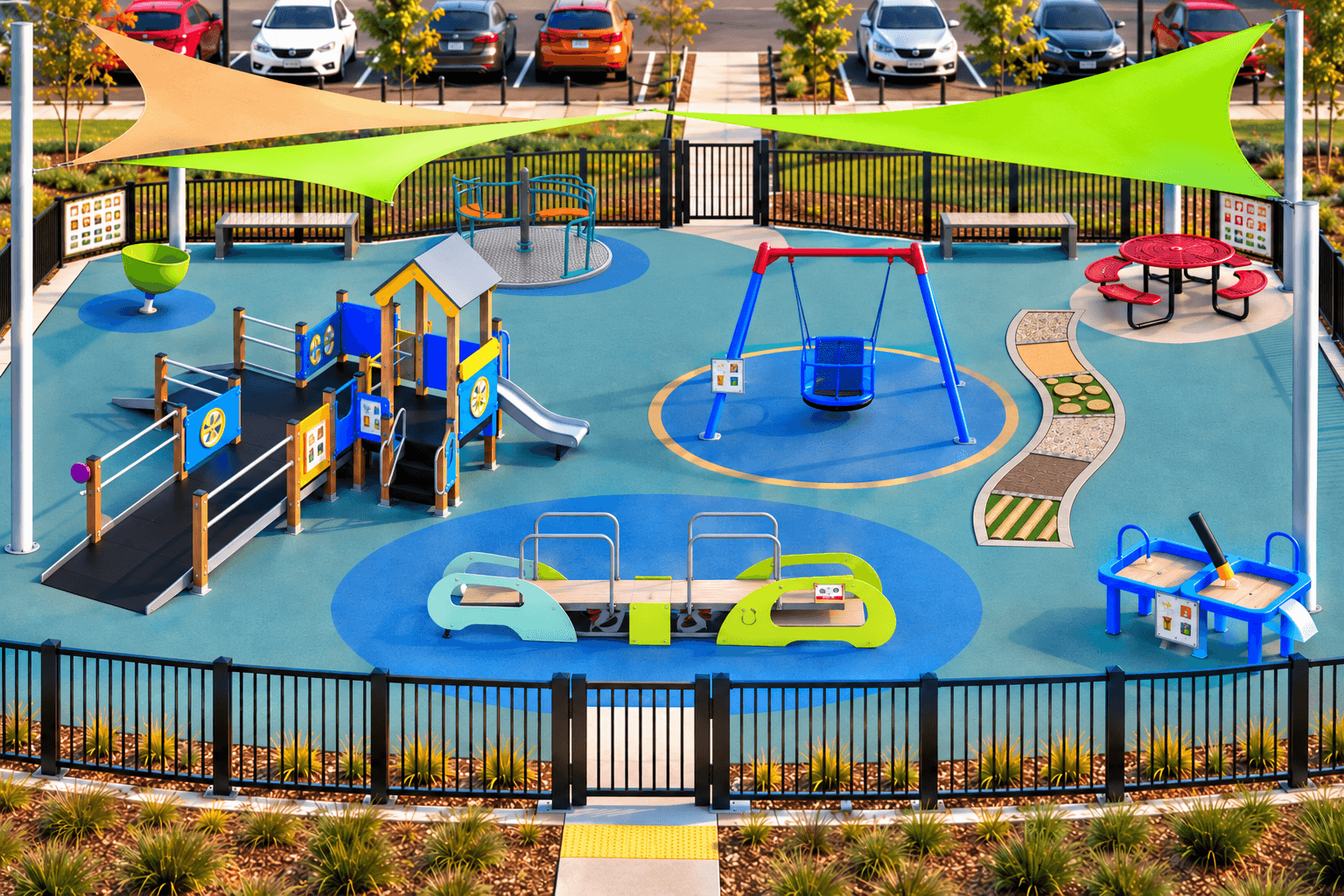
We discussed communication/core boards with relevant symbols, and Braille incorporated throughout the playground, including directly on play equipment, positioned at heights children using wheelchairs can comfortably reach. Communication shouldn't require a child to leave the play area or stop interacting with their friends.
Another focus was incorporating a variety of sensory play equipment, recognising that some children seek movement, sound, and tactile experiences, while others need quieter spaces or opportunities to explore at their own pace.
We also thought carefully about safety, including fencing, secure entry and exit points, and playground layouts that allow parents and caregivers to supervise their children without constantly worrying about nearby hazards.
Lastly, we talked about ramps.
A ramp might make a playground look accessible, but what happens when a child reaches the top and has nothing meaningful to do? Being able to enter a play structure is not the same as being able to participate in the activities it offers.
We don't want ramps that lead nowhere, communication boards children can't reach, or accessible equipment that separates children from their friends. We want every feature to have a genuine purpose.
We know no single design can perfectly accommodate everyone's needs. Our lived experiences are only part of a much bigger picture; we won't know everything. That is why we believe listening to children, disabled people, families, and others with lived experience matters, and we appreciate people sharing what works for them.
Inclusive playgrounds aren't a "nice to have"; they are a necessity. For us, the playground also isn't simply about installing inclusive equipment. It is about creating opportunities for children to communicate, explore, feel safe, make friends and experience the joy of playing together.