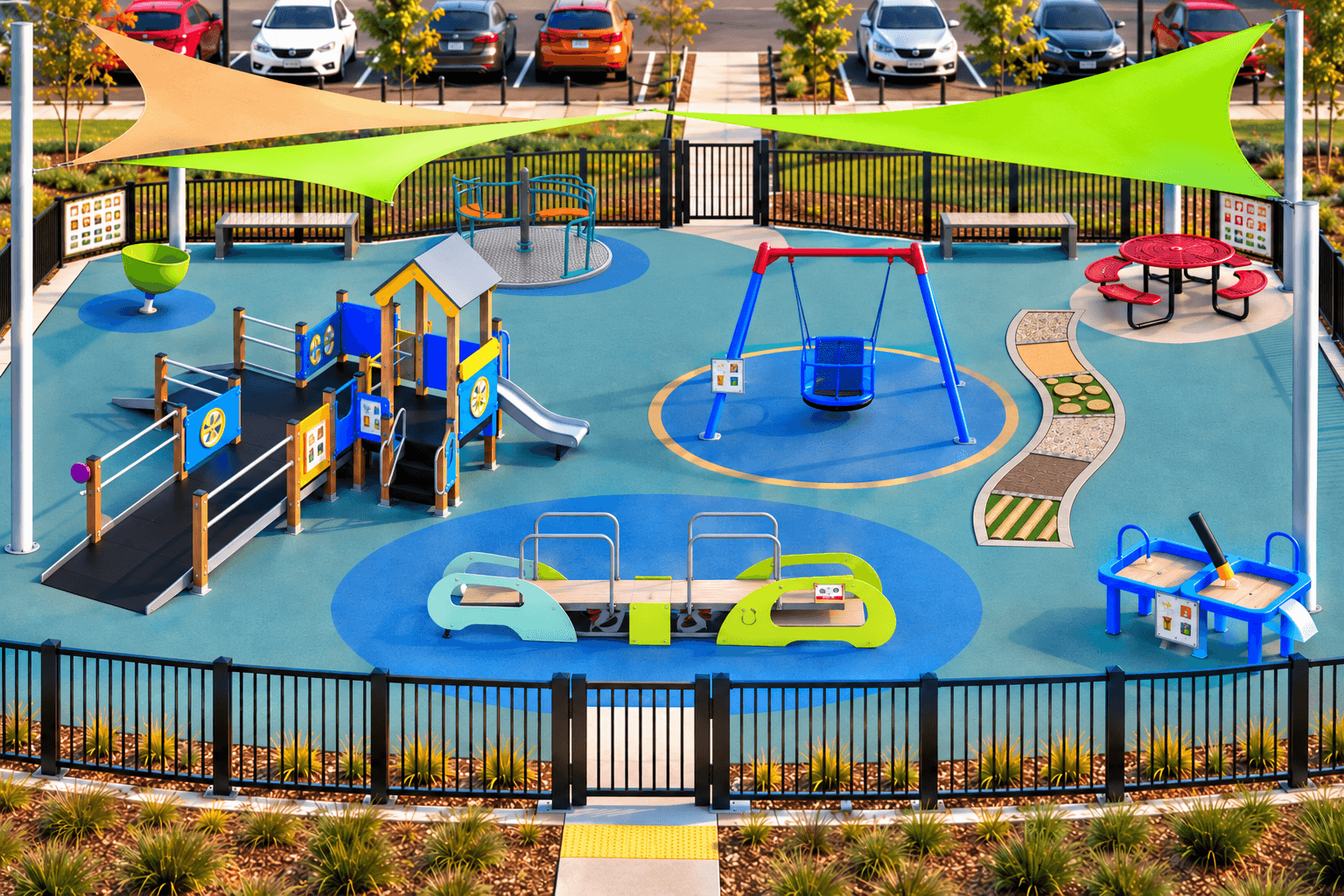
The Accessible Playspace Model
What could a playground look like if accessibility was considered from the beginning — rather than added afterwards?
This concept has been developed to demonstrate how children with different mobility, communication and sensory needs can be considered throughout an entire playspace.
It is not about creating a separate playground for disabled children. It is about creating a playground where children can play together.
What Makes This Playspace Different?
The individual equipment can change from one community to another. What matters are the accessibility principles behind the design.
Step-Free Play
Ramped and step-free access allows children using wheelchairs and other mobility equipment to participate within the play structure rather than watching from the ground.
Accessible Play Equipment
Play experiences are included that can be enjoyed by children with different mobility needs, including children who may not be able to transfer easily from their wheelchair.
Different Ways to Play
Swinging, spinning, rocking, climbing, sliding, sensory exploration and interactive activities provide different ways for children to participate.
Communication Boards
Communication supports can help children who are non-speaking or communicate differently express choices, needs, feelings and ideas while they play.
Sensory Experiences
Tactile pathways, water play and sensory activities provide opportunities for exploration while remaining connected to accessible circulation routes.
Families Belong Too
Accessible seating, picnic areas, shade and spaces to rest recognise that parents, grandparents, caregivers and family members may also have accessibility needs.
Space to Move
Good circulation space matters. Wheelchairs and other mobility equipment need room to approach equipment, manoeuvre, turn and move between activities.
Shade & Comfort
Shade and places to rest help create a playspace that children and families can enjoy for longer periods, including people who may tire easily.
Playing Together
The goal is not simply access to equipment. The goal is participation, friendship and opportunities for disabled and non-disabled children to share play experiences.
Accessible From the Gate to the Play
A child should be able to enter a playground, move through it and reach meaningful play experiences.
Accessible routes should connect the entrance, equipment, sensory activities, seating, picnic areas and other important parts of the playspace.
Accessibility should be part of the whole playground — not an isolated piece of equipment at the edge.
Designed With Lived Experience
People who experience accessibility barriers can bring valuable knowledge to playground planning. Their involvement should begin early in the design process rather than after major decisions have already been made.
Listen Before Designing
Include disabled people, children, families and people with lived experience when establishing the goals of the project.
Design the Whole Journey
Consider parking, pathways, entrances, gates, surfacing, circulation, equipment, seating, shade and supporting facilities together.
Create Choice
Children have different abilities and preferences. Provide different ways to move, communicate, explore, socialise and play.
Design for Participation
Ask more than “Can a wheelchair reach this?” Ask whether a disabled child can participate in the play experience alongside other children.
Starting With Pohe Island, Whangārei
The concept shown above was developed while exploring an accessible play extension for Pohe Island in Whangārei.
But the idea is much bigger than one playground.
The equipment, layout and size can be adapted for different sites, communities and budgets while retaining the central principle: children with different abilities should have meaningful opportunities to play together.
We would love to see communities throughout New Zealand use this concept as inspiration when planning new playgrounds or renewing existing ones.
Could This Work in Your Community?
This concept is intended to start conversations about what better accessible play could look like.
Councils
Use the principles when planning new playgrounds, renewals and community consultation.
Schools
Consider how playgrounds and outdoor learning environments can include children with different access needs.
Communities
Use the model to start conversations with councils, funders and local organisations about accessible play.
Help Us Promote Better Accessible Play
Accessible Playgrounds NZ is part of the Children with Disability NZ network. We want accessibility and lived experience to be considered from the beginning whenever playgrounds are designed or renewed.
If you are a council, school, playground designer, community organisation, funder or family interested in accessible play, we would like to hear from you.
Contact Us Learn About Full Inclusion